CPR and Defibrillator Basics Everyone Should Know
When someone collapses and stops breathing normally, the few minutes that follow matter more than almost anything else. Knowing how to start CPR and how to use a defibrillator gives that person a real chance — and you do not need to be a medic to help.
Cardiac arrest can happen to anyone, anywhere — at work, at home or in the street. It is not the same as a heart attack: a heart attack is a blockage problem, while a cardiac arrest is an electrical fault that stops the heart pumping. The casualty becomes unresponsive and stops breathing normally, and without help they will not recover. The good news is that bystander action keeps the brain and vital organs supplied with oxygen until the emergency services arrive, and that action is far simpler than most people expect.
In the UK, employers have duties under the Health and Safety (First-Aid) Regulations 1981 to make sure there is enough first-aid provision for the workplace. But knowing the basics is something everyone can carry beyond the office, and it costs nothing to learn. This guide walks through the recognised approach used in UK first-aid training.
Start with DRABC
UK first aiders are taught to follow a simple, ordered checklist known as DRABC. It keeps you calm and stops you skipping a step that could put you, or the casualty, at greater risk.
- D — Danger. Check the area is safe. Look for traffic, electricity, fire or anything that could harm you. You are no use to anyone if you become a second casualty.
- R — Response. Gently shake the shoulders and ask loudly, "Are you all right?" If there is no response, treat the situation as an emergency.
- A — Airway. Tilt the head back and lift the chin to open the airway.
- B — Breathing. Look, listen and feel for normal breathing for up to ten seconds. Occasional gasping is not normal breathing.
- C — Circulation / CPR. If they are not breathing normally, call 999, ask for an ambulance and start chest compressions.
How to give chest compressions
Chest compressions are the heart of CPR. Kneel beside the casualty, place the heel of one hand in the centre of the chest, place your other hand on top and interlock your fingers. Keep your arms straight and your shoulders directly above your hands.
- Push hard and fast. Press down about 5–6 cm and let the chest come fully back up between each push.
- Aim for a steady rhythm of roughly 100–120 compressions a minute. Many people find the beat of a familiar upbeat song helps them keep pace.
- Do not stop unless the casualty starts to recover, a defibrillator is ready to analyse, or a professional takes over.
If you are trained and willing, you can add rescue breaths in cycles of 30 compressions to two breaths. If you are not trained or you are unsure, hands-only CPR is far better than doing nothing at all.
The single biggest mistake is hesitation. A person in cardiac arrest is already in the worst possible situation — anything you do to keep blood moving can only help.
How an AED works
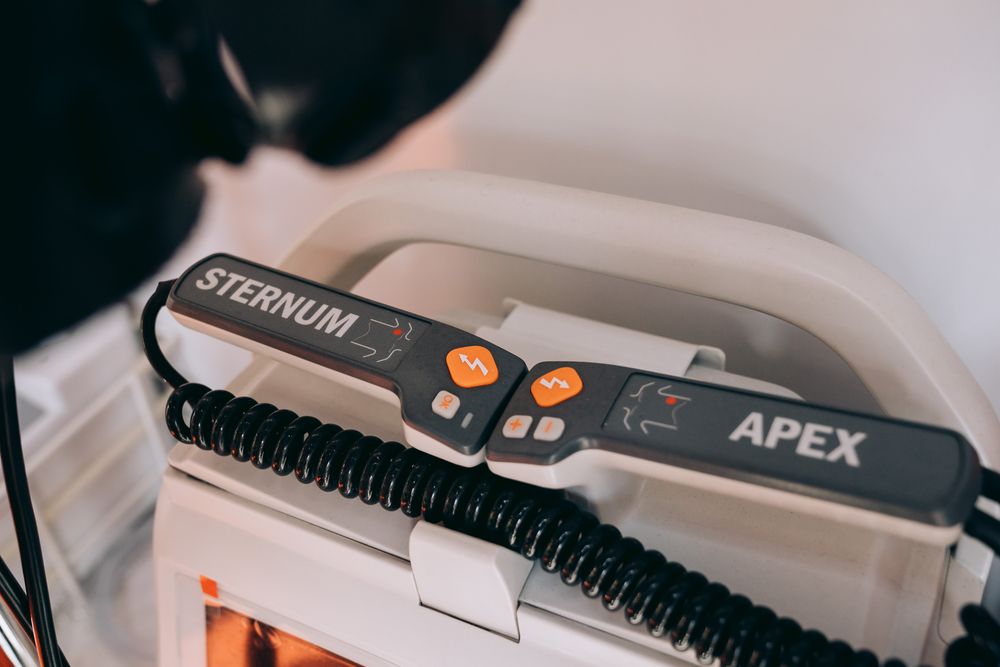
An automated external defibrillator (AED) is the yellow or green box you now see in shopping centres, gyms, stations and many workplaces. It is designed for untrained members of the public. Once you switch it on, it talks you through every step out loud.
- Open the unit and follow the spoken prompts.
- Peel off the backing and place the pads on the bare chest exactly as shown in the pictures.
- Stand clear while the AED analyses the heart rhythm — it will only deliver a shock if one is needed.
- If a shock is advised, make sure no one is touching the casualty, then press the flashing button.
- Resume chest compressions straight away and keep following the prompts until help arrives.
You cannot accidentally shock someone who does not need it — the device checks the rhythm first. The earlier an AED is used alongside good CPR, the better the outcome tends to be, which is exactly why public-access defibrillators have spread across the UK.
Workplace First Aid training from £23
Self-paced, HSE-aligned, certificate the same day — £23 per person.
Why these skills support trained first aiders
Knowing the basics does not replace formal training — it complements it. In a real emergency, a workplace may have one or two appointed first aiders, but they cannot be everywhere at once. When colleagues understand DRABC and can start compressions before the designated first aider arrives, those vital first seconds are not wasted.
Getting the right number of trained people in place is a separate but related question. Our guide on how many first aiders you need explains how to size your provision, and the wider first aid at work guide covers kits, signage and responsibilities. Structured workplace first aid training turns nervous bystanders into confident responders.
Key takeaways
- Cardiac arrest is an electrical fault that stops the heart — bystander action buys time.
- Follow DRABC: Danger, Response, Airway, Breathing, Circulation/CPR.
- Push hard and fast in the centre of the chest, around 100–120 compressions a minute.
- An AED is safe and self-explaining; it only shocks when needed.
- These skills support, but do not replace, trained workplace first aiders.
Confidence comes from practice and from understanding the sequence before you ever need it. Take a little time to learn the basics now, and you will be far calmer if the moment ever comes.