Free, practical guides written by our training team — from manual handling and lifting technique to fire safety, first aid and food hygiene. Get to grips with the essentials, then get certified in minutes.
Our online safety courses are benchmarked to the requirements of:
Back pain is one of the biggest causes of lost working days in Britain — and much of it traces back to how loads are lifted and carried. The good…
Read article →
Many UK employers assume a manual handling certificate "expires" after a fixed number of years. In truth, the law sets no such deadline — but that…
Read article →
A manual handling risk assessment sounds bureaucratic, but at its core it is just a structured way of asking: "Could this lift hurt someone, and…
Read article →
It is one of the most common questions UK employers ask, and the short answer is yes — wherever work involves a real risk of injury from lifting,…
Read article →
The safest lift is often the one you never make yourself. From humble sack trucks to powered hoists, manual handling aids let equipment take the…
Read article →
An ignored handling risk is not just a welfare failure — it is a criminal one. From HSE notices to unlimited fines, personal director liability…
Read article →
Lifting, carrying and moving loads by hand is part of nearly every job in Britain — and it is also one of the leading causes of workplace injury.…
Read article →
"What's the maximum I'm allowed to lift?" is one of the most common questions in any UK workplace — and the honest answer surprises most people.…
Read article →
Most people picture manual handling as something that happens in warehouses and on building sites, not at a desk. But offices are quietly full of…
Read article →
In care work, manual handling is not about boxes and pallets — it is about people. Helping someone move from a bed to a chair, repositioning them…
Read article →
Warehousing and logistics run on movement — goods in, goods picked, goods packed, goods out. Behind the conveyors and forklifts, human hands still…
Read article →
Heavy blocks, sagging cement bags and full-height boards, carried across mud and passed up scaffolds — construction packs more handling risk into…
Read article →
Wheeling a trolley or pallet truck feels far easier than lifting — but pushing and pulling injuries are common and easily overlooked.…
Read article →
Most lifting injuries do not happen because the load was too heavy. They happen because the lift was done badly. Master a simple sequence — plan,…
Read article →
If you remember only one thing about assessing a lift, make it TILE. This four-letter prompt — Task, Individual, Load, Environment — turns a vague…
Read article →
When a load is too heavy for one person, the obvious answer is to grab a colleague. But two people lifting together is not simply twice as safe —…
Read article →
A pulled back or a strained shoulder rarely looks like a balance-sheet problem — until you add up the absence, the cover, the claims and the…
Read article →
The Manual Handling Operations Regulations 1992 — usually shortened to MHOR — are the backbone of lifting and carrying law in Britain. Strip away…
Read article →
Manual handling is one of the largest single causes of workplace injury in the UK. Most of that harm is not dramatic — it builds slowly, or…
Read article →
Ladders are not banned, and they never have been. Used for the right task, set up correctly and in good condition, a ladder is a perfectly…
Read article →
Falls from height are consistently among the leading causes of serious workplace injury in Britain. The good news is that they are also highly…
Read article →
Pick the wrong access equipment and even a careful worker is exposed to risk. The Work at Height Regulations 2005 do not name a single "best"…
Read article →
Falls from height remain one of the most serious risks in British workplaces. The Work at Height Regulations 2005 set out exactly what employers…
Read article →
Falls from height remain one of the biggest causes of workplace death in Britain, year after year. Yet most of these incidents are preventable.…
Read article →
Most abrasive wheel accidents are not freak events. They follow a small set of predictable causes, and almost all of them are preventable with the…
Read article →
Abrasive wheels are among the most useful tools on any British worksite, and among the most unforgiving. This guide explains what they are, why…
Read article →
Abrasive wheels are a textbook example of dangerous work equipment, and the Provision and Use of Work Equipment Regulations 1998 are the rules…
Read article →
Changing an abrasive wheel looks routine, but it is one of the most safety-critical jobs on a worksite. Get the inspection, flanges or speed wrong…
Read article →
Asbestos was used in millions of British buildings until it was finally banned, and it is still present today. If your work could disturb it, the…
Read article →
Asbestos was banned in the UK long ago, yet it still claims more lives at work than any other single cause. The reason is a cruel one: the harm…
Read article →
Asbestos remains the single most heavily regulated material a British worker is ever likely to meet. The Control of Asbestos Regulations 2012 set…
Read article →
Asbestos was a builder's favourite for most of the twentieth century, so it can turn up almost anywhere in a property built or refurbished before…
Read article →
Not all fires are the same, and the extinguisher that puts one out can make another far worse. In the UK, fires are grouped into classes by the…
Read article →
Fire safety is not a box-ticking exercise — it is a legal duty with real teeth. Get it wrong and the consequences range from a formal notice to an…
Read article →
Fire is one of the few workplace hazards that can destroy a business in minutes and put lives at risk before anyone has time to react. If you run…
Read article →
A fire marshal is the person who keeps a level head when the alarm sounds. Becoming one is straightforward, but the role carries real legal weight…
Read article →
A fire risk assessment is the legal foundation of fire safety in almost every UK workplace. Done well, it is not paperwork — it is the process…
Read article →
A fire extinguisher is only useful if you know how to use it and which one to reach for. Grab the wrong type and you can make a fire far worse.…
Read article →
When someone collapses and stops breathing normally, the few minutes that follow matter more than almost anything else. Knowing how to start CPR…
Read article →
Every UK employer has a legal duty to make sure their staff can be given immediate help if they are injured or taken ill at work. Yet the rules…
Read article →
There is no single magic number written into UK law. Instead, the Health and Safety (First-Aid) Regulations 1981 ask every employer to work it out…
Read article →
We accept that someone might cut their hand or twist an ankle at work — and we keep a first-aid kit ready for it. Mental health first aid applies…
Read article →
The right protective equipment is the kit that fits the hazard, fits the person, and fits together with everything else they wear. Work through…
Read article →
In 2022 the rules on personal protective equipment quietly widened to cover a much larger slice of the British workforce. If you manage people,…
Read article →
Does your boss pay for your safety boots? Must you wear the gloves they hand you? PPE law splits the duties neatly between employer and worker —…
Read article →
The hardest truth about confined spaces is that the rescuer often dies too. The same atmosphere that fells the first worker fells the second.…
Read article →
Confined space entry is governed by a strict order: avoid it, control it, and plan for rescue. Permits, planning and atmospheric testing are what…
Read article →
A confined space is not defined by how cramped it is — it is defined by danger. Under UK law, even a large open-topped tank can qualify. Here is…
Read article →
From cleaning products to welding fume, hazardous substances are part of daily work in most UK organisations. A COSHH risk assessment is how you…
Read article →
A risk assessment is the cornerstone of UK health and safety law, yet many people find the blank page daunting. This guide explains what a risk…
Read article →
People often talk about "RAMS" as if it were a single document, but a risk assessment and a method statement do two different jobs. Understanding…
Read article →
The five-step method is the most widely recognised way to carry out a workplace risk assessment in the UK. It turns a broad legal duty into a…
Read article →
If you spend most of your day at a screen, the way your workstation is set up quietly shapes how your neck, back and eyes feel by five o'clock. A…
Read article →
Home working is now a permanent feature of UK working life — but your responsibility for staff does not stop at the office door. Here is a…
Read article →
For someone with a serious food allergy, a single mislabelled sandwich can be a matter of life or death. UK law treats it that way too — and every…
Read article →
Level 1, Level 2, Level 3, Level 4 — food hygiene training comes in tiers, and choosing the wrong one wastes money or leaves a gap. Here is…
Read article →
Temperature is the single most powerful lever any food business has over harmful bacteria. Get the numbers right and you stop most foodborne…
Read article →
HACCP sounds like an acronym only food scientists use, but every UK café, kitchen and food unit relies on it. Here is what HACCP actually means,…
Read article →
Cross-contamination is one of the most common — and most preventable — causes of food poisoning and allergic reactions. It happens whenever…
Read article →
Every adult in a school shares responsibility for keeping children safe — not just the safeguarding team. This practical guide breaks down the…
Read article →
A safety culture is what people do when no one is watching. You cannot mandate it into existence with another policy document, but you can build…
Read article →
A health and safety breach is rarely a small problem. Beyond the human cost of an injury, UK employers face an enforcement regime that can reach…
Read article →
Most UK employers do not have a training problem — they have a visibility problem. The courses get done, but the certificates end up scattered…
Read article →Self-paced, HSE-aligned, available in 20 languages. Pass the short assessment and download your certificate the same day — valid for 3 years.
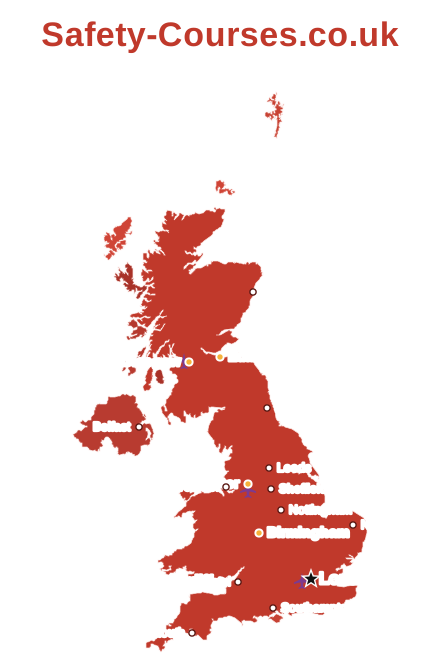
Take your course online from London, Manchester, Birmingham, Glasgow, Cardiff or Belfast - or anywhere in the UK. Learn at your own pace on any device, and finish with an instant HSE-aligned certificate that's accepted right across the country.
We use strictly necessary cookies to make this website work. With your consent we also use analytics cookies to understand how the site is used and improve it. You can accept all, reject non-essential cookies, or set your own preferences. Read our Cookie Policy.