
Abrasive Wheel Accidents: Causes and How to Prevent Them
Most abrasive wheel accidents are not freak events. They follow a small set of predictable causes, and almost all of them are preventable with the right controls, equipment and training. Here is what goes wrong, why, and how to stop it happening on your worksite.
Wheel breakage
The most serious abrasive wheel accident is a wheel that shatters in use. When a spinning wheel fails, fragments are thrown out with enormous force, and the injuries can be life-changing or fatal. The usual causes are well known: running a wheel above its marked maximum speed, fitting a wheel with hidden cracks, mounting it with the wrong or damaged flanges, omitting the blotter, or striking the wheel against the workpiece. Many of these trace back to errors at the moment of fitting, which is why we cover the safe sequence in detail in our guide to mounting and changing a wheel safely.
Prevention is straightforward in principle: inspect and ring test wheels, confirm the wheel's maximum speed against the spindle speed every time, use correct flanges and blotters, and keep the guard in place to contain any failure. None of these steps is difficult; they simply have to be done every time, without exception.
A guard does not stop a wheel breaking, but it can stop the fragments reaching the operator. That is why it is never optional.
Contact injuries
Even a wheel that never breaks is dangerous to touch. A moving abrasive wheel can inflict deep lacerations and abrasions in a fraction of a second, and angle grinders are notorious for kickback, where the tool jumps suddenly towards the user if the wheel binds or the disc catches an edge. Loose clothing, gloves caught in the wheel, and working without a firm grip all add to the risk. Controls include keeping the guard correctly positioned, maintaining a secure stance and two-handed grip on portable tools, never removing safety features, and ensuring the workpiece is properly clamped or supported.
Eye and face injuries
Grinding throws off a constant stream of sparks, grit and fine particles. Without proper eye protection, a single fragment can cause a serious eye injury, and these are among the most common incidents reported with abrasive wheels. The control is simple and non-negotiable: appropriate eye protection, and often a face shield over it, worn by the operator and by anyone nearby. Screens or barriers should be used where others work close to the grinding area.
Abrasive Wheels training from £23
Self-paced, HSE-aligned, certificate the same day — £23 per person.
Dust and hand-arm vibration
Not every harm from abrasive wheels is sudden. Grinding generates fine dust that can damage the lungs over years of exposure, particularly where materials contain silica. And the vibration transmitted through hand-held grinders and cut-off saws is a leading cause of hand-arm vibration syndrome (HAVS), a painful and irreversible condition affecting the nerves, blood vessels and joints of the hand and arm.
These risks call for different controls. For dust, use extraction or on-tool suppression, work in well-ventilated areas, and provide suitable respiratory protection where needed. For vibration, choose lower-vibration tools where possible, keep wheels sharp and in good condition, limit continuous trigger time, rotate tasks, and keep hands warm. Both hazards also need health surveillance where exposure is significant.
Fire and sparks
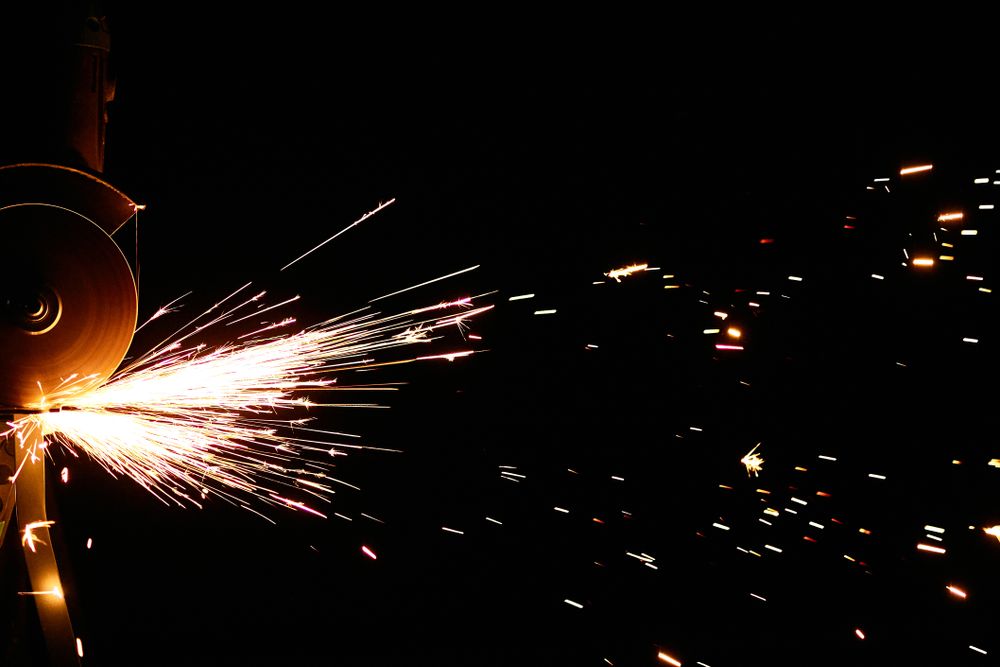
The shower of sparks from grinding is a genuine ignition source. Hot particles can travel a surprising distance and smoulder unnoticed in dust, packaging or other combustible material, leading to fires that start long after the work has finished. Before any grinding near flammable materials, clear the area, screen the work, keep suitable fire-fighting equipment to hand, and put a fire watch in place during and after the task where there is any risk.
PPE and good practice in summary
- Eye protection and a face shield for the operator and anyone nearby.
- Respiratory protection and dust control where dust is generated.
- Hearing protection, as grinding is frequently loud.
- Close-fitting clothing, no dangling items, and care with gloves around moving wheels.
- A correctly fitted and adjusted guard at all times, never removed.
The common thread: training
Look across all of these causes and one factor recurs: the person at the machine. A trained operator selects the right wheel, checks the speed, recognises a damaged wheel, keeps the guard in place, wears the right protection and works in a way that limits dust, vibration and fire risk. Training also underpins an employer's legal position, since the duty to provide adequate information, instruction and training runs through the relevant law, as we explain in our overview of abrasive wheels and PUWER 1998.
Key takeaways
- Wheel breakage is the most severe accident; over-speeding, cracks and wrong flanges are the usual causes.
- Contact and eye injuries are the most frequent; guards and eye protection are the front-line controls.
- Dust and vibration cause long-term harm: control with extraction, low-vibration tools and limited exposure.
- Sparks are an ignition source; clear and screen the area and keep a fire watch where needed.
- Trained operators and the right PPE prevent the great majority of abrasive wheel accidents.
Abrasive wheel accidents are largely a problem of preventable error, and the most cost-effective single control is competent, trained operators. Our online Abrasive Wheels course from £23 is HSE-aligned, self-paced and issues a certificate the same day, covering the hazards above, the controls that stop them, and the PPE that protects the people doing the work.