How Often Should Food Hygiene Training Be Refreshed?
“Is my food hygiene certificate still valid?” is often asked as if there were a single legal renewal date. UK food hygiene rules do not generally set a fixed expiry period for every food handler’s certificate. The duty is to ensure staff are supervised and instructed and/or trained in food hygiene matters appropriate to their work. That duty continues after an induction course and after any date printed on a provider’s certificate.

Separate certificate validity from competence
A training provider may state that its certificate is valid for three years, or an employer may set a three-year renewal policy. Those can be useful administrative prompts, but they are not a universal statutory rule requiring every worker to retake a particular course on that date. Equally, a certificate with time left on it does not prove a handler can safely perform a newly assigned task.
Consider a café employee who completed general catering training two years ago and now takes responsibility for prepacked sandwiches. They need instruction in the current recipe, allergen records, label approval process and controls for cross-contact before starting that work. Waiting another year for the diary reminder would miss the immediate need.
Triggers for refresher training
Refresh learning when the job or the risk changes. Examples include a new menu item, unfamiliar equipment, a revised cleaning product, a different cooling or hot-holding process, or a change in allergen labelling. Staff also need a prompt response to an incident, customer complaint, near miss, inspection finding or repeated failure of a routine check. A long absence or transfer to another site may warrant a fresh induction.
Watch work in practice. If employees can recite the correct temperature but do not use a probe correctly, coach the hands-on task. If allergen answers vary by shift, review the information source and escalation process. Refresher training should target the gap that matters, not merely repeat an entire slide deck for the sake of a date.
Build a sensible review cycle
Many businesses choose a regular review cycle, often around every few years, to revisit core food hygiene topics. Set a frequency that fits your food risks, staff turnover and the employer’s own policy. Add shorter briefings between formal courses: a ten-minute demonstration of safe probe use or a discussion of a revised salad recipe can be more timely than a course scheduled months away.
A supervisor should check both knowledge and behaviour. Ask staff to show how they separate raw and ready-to-eat foods, explain what they do if the fridge is too warm and locate the current allergen information. Use observations and records to decide whether a targeted refresher is enough or whether a fuller course is appropriate.
Keep useful evidence
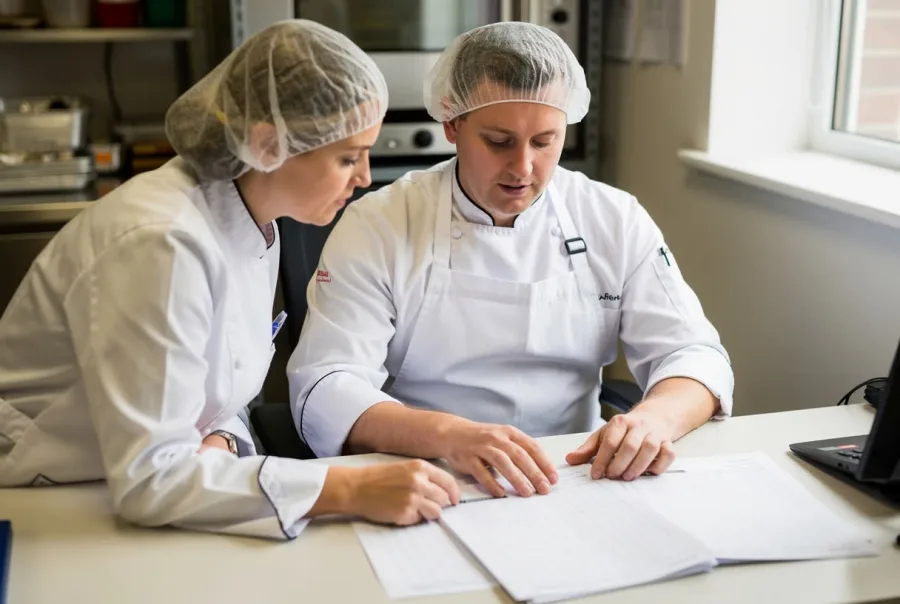
Record the employee, role, date, subject, instructor or course, and any practical check. Note why refresher learning was given and whether follow-up was needed. The FSA’s Safer Food, Better Business diary includes a staff training record, which can sit alongside induction records and course certificates. Make the record easy for managers to update during normal work.
When procedures change, update the written food safety method and tell everyone affected. If only the morning shift receives the briefing, the business has not closed the gap. Ask the next supervisor to confirm that the new method is understood on the evening shift too.
Choose training by responsibility
For kitchen handlers, Food Hygiene for Catering Level 2 can be a structured refresher of the main principles. A new worker with limited duties may begin with Food Hygiene & Safety Level 1. A manager who oversees a HACCP-based system may need HACCP Level 3 and a focused review of the site’s actual plan. Choose by task, then confirm that learning appears in practice.
The best renewal question
Instead of asking only when the certificate expires, ask whether each person can still do today’s work safely and whether the business can show how it knows. Review that question after changes and at planned intervals. The FSA’s hygiene training record guidance recommends considering periodic refresher training as necessary. That is a useful standard: timely, relevant learning supported by supervision and good records.
Catering Food Hygiene training online
Self-paced online course with an assessment and a downloadable certificate.
Make refreshers short enough to happen
A useful refresher may be a course, a practical demonstration or a shift briefing, depending on the gap. Set one clear outcome: after a probe demonstration, the worker should place it correctly, wait for a stable reading, clean it and record the result. After an allergen briefing, the server should locate the approved ingredient information and know when to escalate. Record that outcome, then check it later. This keeps learning connected to actual work and prevents a completed attendance list from being mistaken for competence.
For multi-site teams, compare local methods before transferring staff. The same training course does not mean two kitchens use identical equipment or escalation routes.
Include supervisors in refreshers. They need to recognise drift in practice, interpret records and coach staff fairly. If several workers make the same mistake, check whether the procedure, rota or equipment is contributing before assigning another course to everyone.