How to Carry Out a Fire Risk Assessment (5 Steps)
A fire risk assessment is the legal foundation of fire safety in almost every UK workplace. Done well, it is not paperwork — it is the process that decides whether everyone gets out alive. Here is how to work through all five steps with confidence.
If you run, manage or simply control any non-domestic premises in England and Wales, the law expects you to know exactly how a fire could start on your site, who would be in danger, and what you have done to prevent it. That expectation sits inside the Regulatory Reform (Fire Safety) Order 2005, usually shortened to the Fire Safety Order or RRFSO. The Order requires the "responsible person" to carry out a suitable and sufficient fire risk assessment and to keep it up to date.
The good news is that the assessment follows a logical, repeatable structure. Government guidance has long described it as a five-step method, and that framework still gives the clearest route through the task. Below we walk through each step the way an experienced assessor would.
Who is the "responsible person"?
Before you start, be clear about who carries the duty. In a workplace, the responsible person is usually the employer. It can also be the owner, the landlord, the managing agent, or anyone who has control of the premises — for example a facilities manager or a tenant in a shared building. More than one person can hold duties at the same time, and where they do, the Order expects them to co-operate and co-ordinate.
You do not need to be a qualified consultant to carry out an assessment in lower-risk premises, but you do need to be competent. That means having enough knowledge, training and understanding to spot the hazards and judge the risk honestly. Where a building is large, complex or high-risk, bringing in a specialist assessor is the sensible choice.
Step 1 — Identify the fire hazards
Fire needs three things together: a source of ignition, a source of fuel and oxygen. Your first job is to walk the premises and find where those three could meet.
- Sources of ignition: heaters, faulty or overloaded electrics, hot work, cooking equipment, lighting that runs hot, smoking areas and even deliberate arson risk.
- Sources of fuel: paper and packaging, waste and rubbish, flammable liquids and gases, furniture, textiles, plastics and stored stock.
- Sources of oxygen: the air around us, but also ventilation systems, oxygen cylinders and anything that feeds extra air to a fire.
Walk every area, including storerooms, plant rooms, loft spaces and the bits people tend to forget. Understanding how different fuels behave also helps you judge severity — our explainer on the classes of fire is a useful companion at this stage.
Step 2 — Identify the people at risk
Next, think about everyone who could be affected if a fire broke out. That includes staff, visitors, contractors and members of the public. Pay particular attention to people who may be more vulnerable, such as those with mobility, hearing or visual impairments, lone workers, night staff, and anyone unfamiliar with the layout.
Ask practical questions: would a wheelchair user be able to leave unaided? Would a worker in a noisy area hear the alarm? Are there sleeping occupants, as in a care home or hotel, who need far more time and support to evacuate? People at higher risk often need a personal emergency evacuation plan.
Step 3 — Evaluate, remove, reduce and protect
This is the heart of the assessment. You weigh up the likelihood of a fire starting against the harm it could cause, then act to bring the risk down to a level that is as low as reasonably practicable.
Start by removing or reducing hazards wherever you can — clear waste promptly, store flammables properly, repair faulty electrics and separate ignition sources from fuel. Then look at the protective measures that limit harm if a fire does start.
The aim is never to prove a fire is impossible. It is to make a fire far less likely, and to make sure that if one does break out, everyone can get out safely before it spreads.
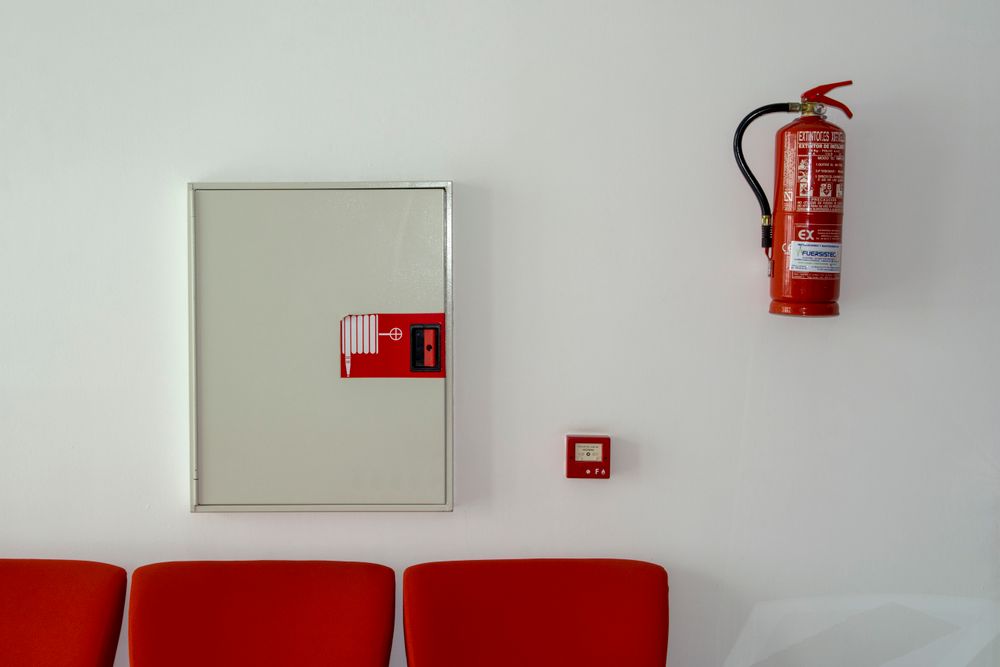
Protective measures include detection and warning systems, clear and unobstructed escape routes, emergency lighting, fire doors, signage and suitable firefighting equipment such as extinguishers. You also need people who know what to do — trained fire marshals, a clear evacuation plan and regular drills.
Fire Safety training from £23
Self-paced, HSE-aligned, certificate the same day — £23 per person.
Step 4 — Record, plan, inform and train
Where you employ five or more people, the significant findings of your assessment must be recorded. In practice it is wise to record them whatever the size of your business — a written assessment is your evidence that you took the duty seriously, and it gives you a baseline to build on.
A good record sets out the hazards you found, the people at risk, the actions you have taken and the actions still outstanding. It should link to your emergency plan, explain how staff are informed, and show how training is delivered. Everyone needs to know the alarm, the routes, the assembly point and who is responsible for what.
Step 5 — Review and revise
A fire risk assessment is a living document, not a one-off. Review it regularly and whenever something changes — a refit, new equipment, a change of use, more staff, or a near miss. If the assessment is no longer valid, revise it. Keeping training current is part of this cycle, which is exactly why so many businesses pair their assessment with an affordable online course.
Key takeaways
- The Fire Safety Order requires the responsible person to carry out and maintain a fire risk assessment.
- The five steps are: identify hazards, identify people at risk, evaluate and reduce, record and train, then review.
- Fire needs ignition, fuel and oxygen — break that triangle to cut the risk.
- Record your significant findings, especially with five or more employees.
- Review whenever the premises, use or staffing changes.
The assessment is only as strong as the people behind it. If your team understands how fire behaves and what to do in those first crucial minutes, every step above becomes more reliable. Our £23 Fire Safety course gives staff that grounding, while our guide to becoming a fire marshal shows who should lead the evacuation on the day.